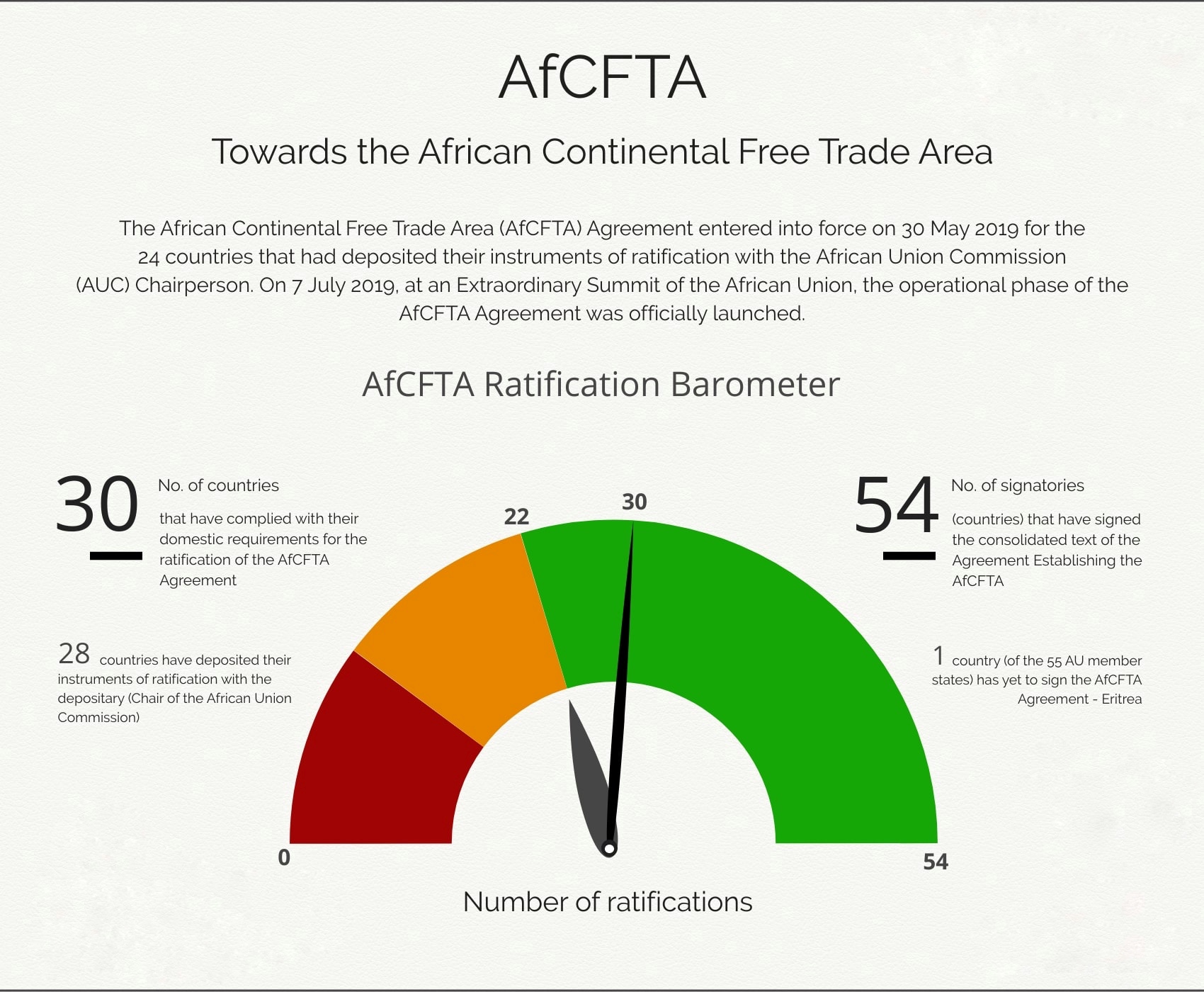
African Continental Free Trade Area (AfCFTA) has been dubbed Africa’s Marshal Plan with an agenda to boost Africa’s economy through the integration and promotion of trade among African nations. A free trade area in Africa will allow the movement of goods, people, services and investments free from travel and tariff barriers. AfCFTA will equally strengthen Africa’s participation in international trade by allowing African nations enter into trade Agreements with developed nations and economic communities such as the EU. A unified stance will strengthen Africa’s bargaining power and create better trading opportunities for African nations.
Presently, 30 out of 54 African nations have ratified the AfCFTA. The five operational instruments governing the AfCFTA are; the rules of origin; the online negotiating forum; the monitoring and elimination of non-tariff barriers; a digital payment system and the African Trade Observatory. Intra-Africa trade under the AfCFTA was set to commence in July 2020 but was delayed due to the COVID-19 pandemic.
Despite the eulogized benefits of the AfCFTA, its implementation has been met with opposition and skepticism.
For one, skeptics assume that African nations trade similar products, largely raw materials, consequently eliminating the need for intra-African trade. However, a report of the Organisation for Economic Co-operation and Development (OECD) debunked this theory. The report concluded that trade among the East African Community (EAC) was more diverse than intra-African trade and included both primary commodities and manufactured goods. It is therefore more likely that increased demand for African products through intra-African trade will in turn trigger the diversification of African goods and services.
Some others postulate that tariff-cuts will retard Africa’s development considering Africa depends on revenue from intra-trade tariff. Such fears are only superficially valid. If properly implemented, the AfCFTA will create a favourable and predictable market attractive to both foreign and national investors. Industries within Africa will be stimulated to produce higher outputs of goods and services to meet demand. It is important to keep the bigger picture in mind, that is; the target market is not just African businesses and people but international investors as well. The EU is the world’s largest exporter of manufactured goods and services and achieved such a feat because of the unified trading system of each EU member state. AfCFTA will definitely expand Africa’s export market to such a level, if not higher, considering Africa’s size, population and rapidly growing economies.
Another fear is that the implementation of AfCFTA is premature. Skeptics theorize that the AfCFTA need operate in a system with a single currency. This is not entirely correct and a more accurate statement may be that AfCFTA will operate better in a continent with a single currency. The process is not to be rushed. It is noteworthy that though the EU was formed in 1993, it took almost a decade for the Euro to be introduced and even longer for each EU member state to adopt. Moreover, Africa is well on its way to adopting a single currency, the Eco, the dynamics of which remain uncertain.
Though the continent’s social, political and economic climate may not be perfect for a unified trading system, the benefits of AfCFTA outweighs its drawbacks and its implementation will surely kickstart the burgeoning of a developed Africa.


